Book Cover Size and Dimensions
A print cover is one flat page: back cover, spine and front cover, plus 0.125 in of bleed on the outside edges. The panels come from the trim size and the spine comes from page count and paper. Everything below is worked out for you, in inches and millimetres, so you can look up the size of your cover file instead of calculating it.
6 x 9 in at 300 pages on white paper: spine 0.676 in, full wrap 12.93 x 9.25 in (328 x 235 mm). Ebook cover: 1,600 x 2,560 px.
Work it out in this order
Every number on a printed cover follows from four decisions. Change one and the file size changes, so make them in this order and leave the trim alone once the interior is laid out.
- Pick the trim. 6 x 9, 5.5 x 8.5, 5 x 8 and 8.5 x 11 in cover most books. The trim comes from the reader and the retail category, and then stays fixed for the whole series.
- Add bleed to the outside edges. 0.125 in on the top, bottom and outside edges, so the artwork can be trimmed without a white sliver. That is +0.25 in on both dimensions.
- Calculate the spine. Page count x paper thickness. A 300-page black-and-white white-paper book is 0.676 in; the same book on cream paper is 0.750 in.
- Keep text inside the safe area. Title, subtitle and back-cover copy stay inside the trim with a margin; background artwork can run into the bleed. Spine type needs 0.0625 in clear on each side of the fold.
Full wrap size by trim
Calculated at 300 pages on black-and-white white paper, the most common combination. Only the width changes with page count; the height belongs to the trim.
| Trim | Each panel | Spine at 300pp | Full wrap file | Millimetres |
|---|---|---|---|---|
| 6 x 9 in | 6 x 9 in | 0.676 in | 12.93 x 9.25 in | 328 x 235 mm |
| 5.5 x 8.5 in | 5.5 x 8.5 in | 0.676 in | 11.93 x 8.75 in | 303 x 222 mm |
| 5 x 8 in | 5 x 8 in | 0.676 in | 10.93 x 8.25 in | 278 x 210 mm |
| 5.25 x 8 in | 5.25 x 8 in | 0.676 in | 11.43 x 8.25 in | 290 x 210 mm |
| 8.5 x 11 in | 8.5 x 11 in | 0.676 in | 17.93 x 11.25 in | 455 x 286 mm |
| 7 x 10 in | 7 x 10 in | 0.676 in | 14.93 x 10.25 in | 379 x 260 mm |
Bleed 0.125 in on the top, bottom and outside edges. Spine uses 0.002252 in per page, KDP's figure for black-and-white white paper. Compare with the printer's current template before upload.
Spine width by paper and page count
Pick the paper, then the page count. Spine width is the two multiplied.
| Interior and paper | Per page | 100 pp | 200 pp | 300 pp | 400 pp | 500 pp |
|---|---|---|---|---|---|---|
| Black & white, white paper | 0.002252 in | 0.225 in | 0.450 in | 0.676 in | 0.901 in | 1.126 in |
| Black & white, cream paper | 0.002500 in | 0.250 in | 0.500 in | 0.750 in | 1.000 in | 1.250 in |
| Standard color, white paper | 0.002252 in | 0.225 in | 0.450 in | 0.676 in | 0.901 in | 1.126 in |
| Premium color, white paper | 0.002347 in | 0.235 in | 0.469 in | 0.704 in | 0.939 in | 1.174 in |
KDP prints spine text only above 79 pages. Below that the spine stays blank, so let the artwork run through it. Need a single number? The spine calculator takes page count and paper and returns the spine width.
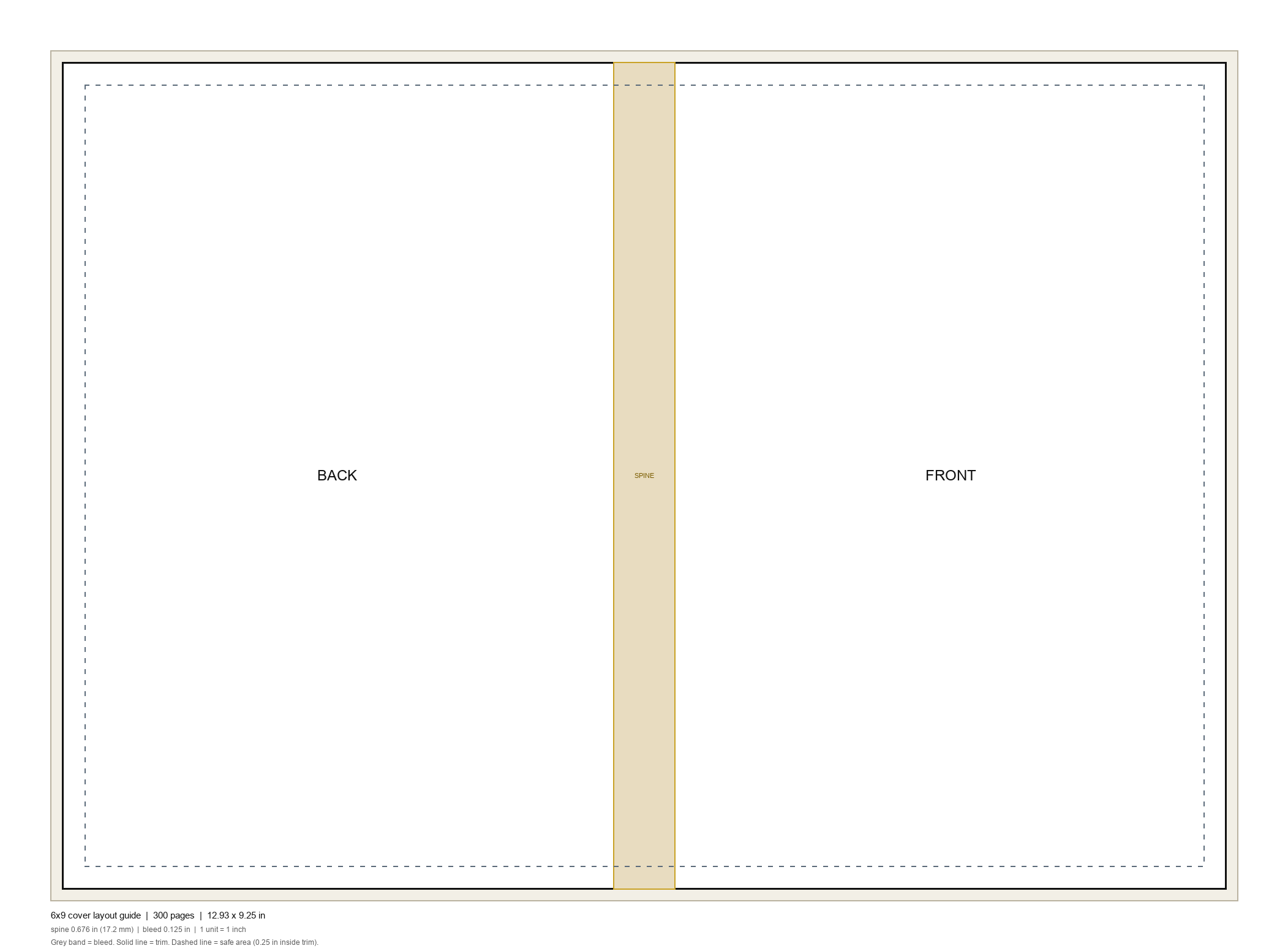
6 x 9 in cover size
The trim most trade fiction and narrative nonfiction uses. Bookstores and reviewers expect it, and the page area keeps the cost per word down.
Panels 6 x 9 in, wrap 12.25 in plus the spine by 9.25 in. At 300 pages on white paper the spine is 0.676 in and the file is 12.93 x 9.25 in; at 200 pages the same book needs 12.70 x 9.25 in.
- Panel: 6 x 9 in
- 200 pages, white paper: spine 0.450 in, wrap 12.70 x 9.25 in
- 300 pages, white paper: spine 0.676 in, wrap 12.93 x 9.25 in
- Hardcover at the same trim uses a different wrap: board, hinge and wrap allowance are extra.
Download the 6x9 layout guide (PDF, 1 unit = 1 inch)PNG version
5.5 x 8.5 in cover size
A digest-size paperback. It uses less paper than 6 x 9, which shows in the print cost, and suits memoir, poetry and short novels.
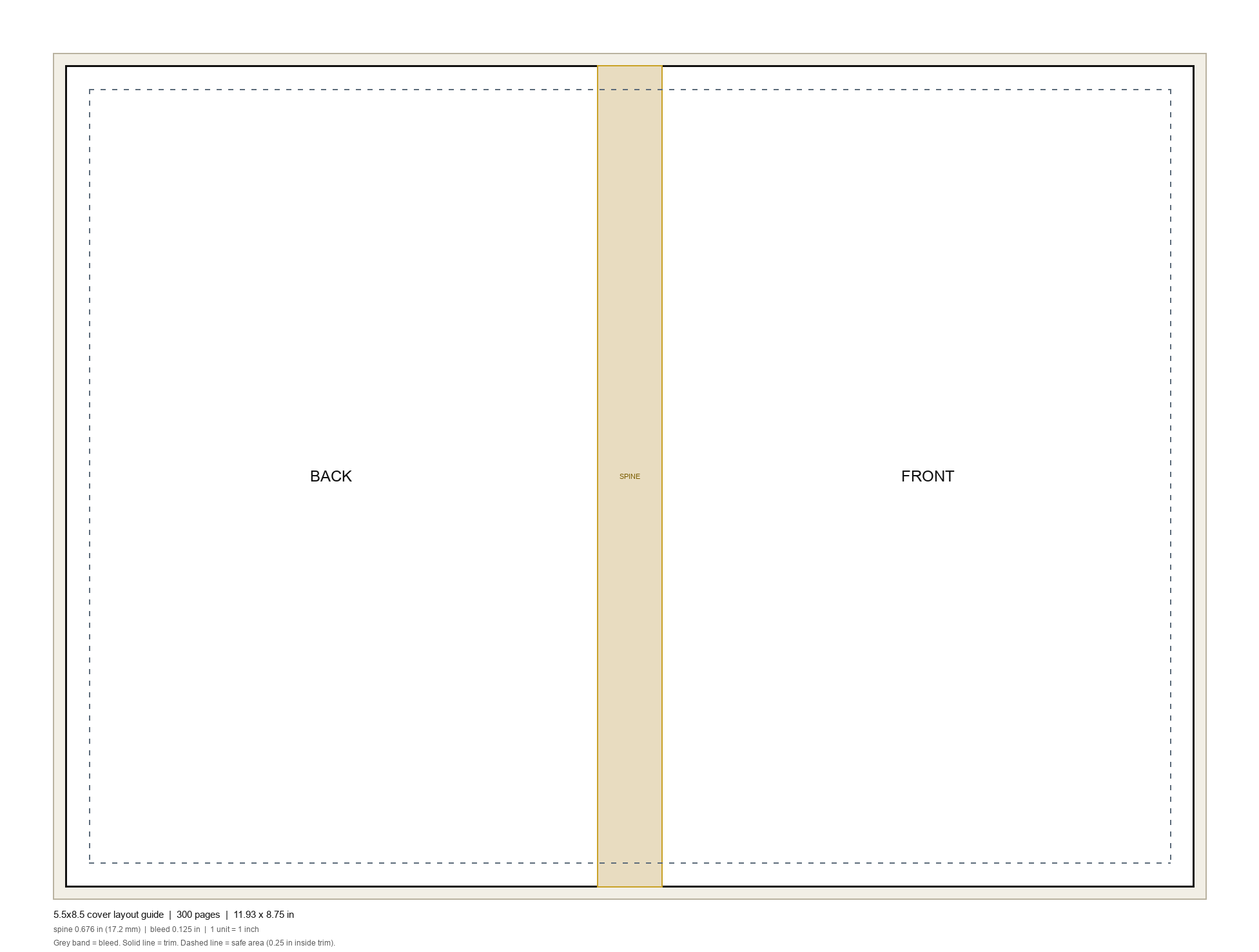
Panels 5.5 x 8.5 in, wrap 11.25 in plus the spine by 8.75 in. A 300-page white-paper book gives 11.93 x 8.75 in; cream paper grows the spine to 0.750 in and the file to 12.00 in.
- Panel: 5.5 x 8.5 in
- 200 pages, white paper: spine 0.450 in, wrap 11.70 x 8.75 in
- 300 pages, white paper: spine 0.676 in, wrap 11.93 x 8.75 in
- Hardcover at the same trim uses a different wrap: board, hinge and wrap allowance are extra.
Download the 5.5x8.5 layout guide (PDF, 1 unit = 1 inch)PNG version
5 x 8 in cover size
The smallest size most printers handle comfortably. Fewer words per page means a higher page count for the same manuscript, so the spine grows.
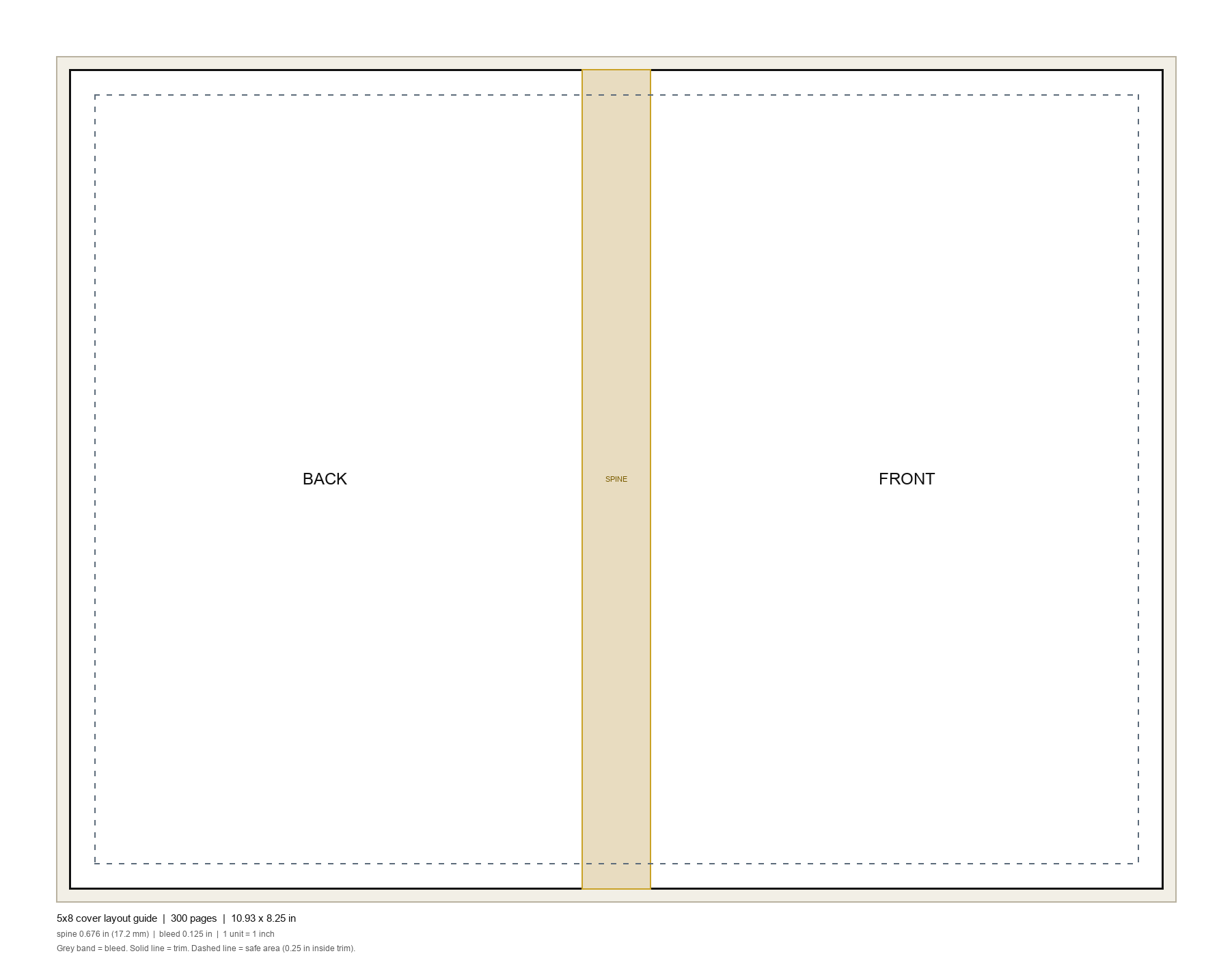
Panels 5 x 8 in, wrap 10.25 in plus the spine by 8.25 in. At 300 pages on white paper that is 10.93 x 8.25 in.
- Panel: 5 x 8 in
- 200 pages, white paper: spine 0.450 in, wrap 10.70 x 8.25 in
- 300 pages, white paper: spine 0.676 in, wrap 10.93 x 8.25 in
- Hardcover at the same trim uses a different wrap: board, hinge and wrap allowance are extra.
Download the 5x8 layout guide (PDF, 1 unit = 1 inch)PNG version
8.5 x 11 in cover size
Workbooks, activity books and manuals use letter size because readers write in them. The panels are large, so the file is large too.
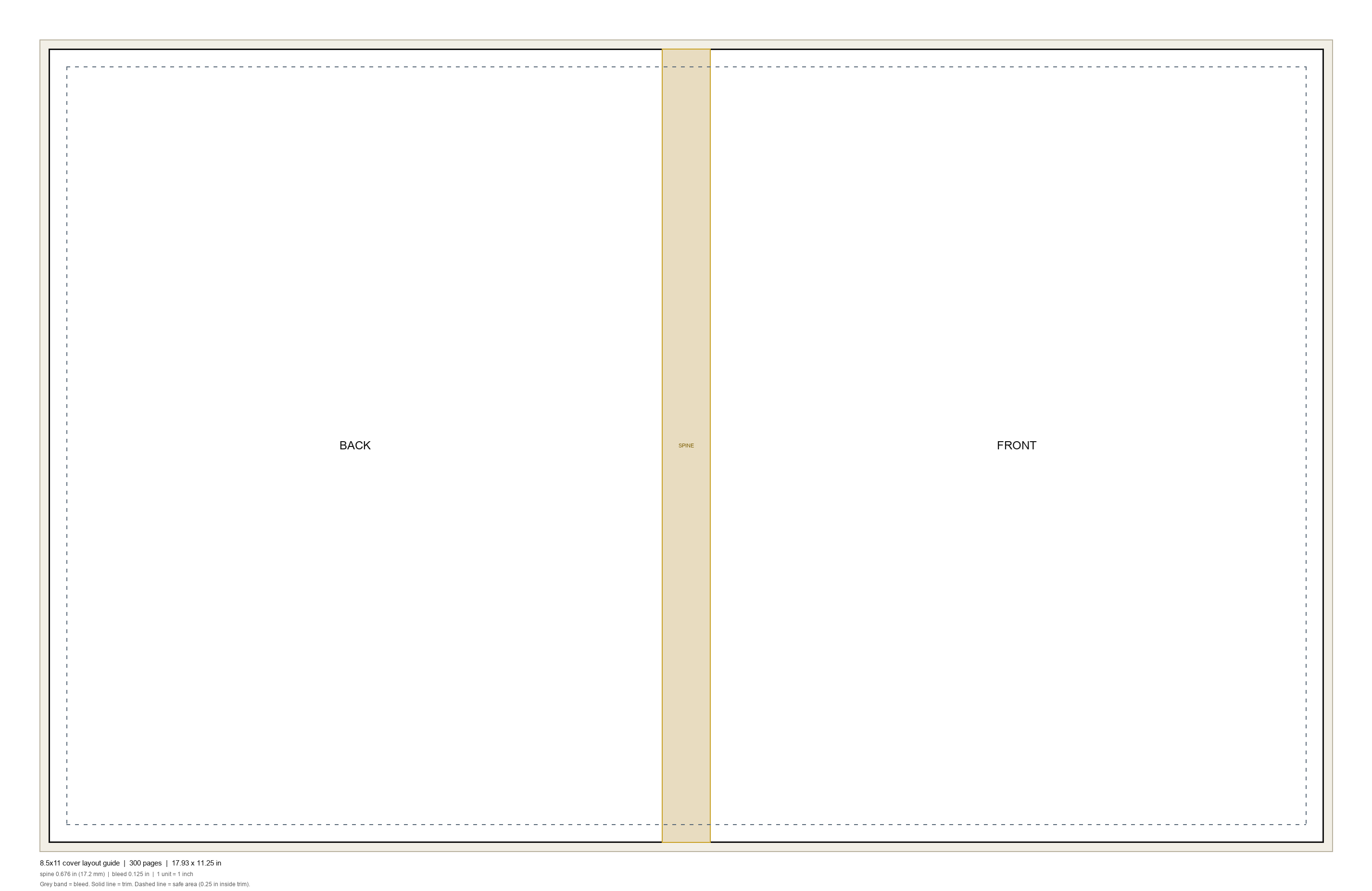
Panels 8.5 x 11 in, wrap 17.25 in plus the spine by 11.25 in: 17.93 x 11.25 in at 300 pages. Check the printer's maximum upload size before you build at this trim.
- Panel: 8.5 x 11 in
- 200 pages, white paper: spine 0.450 in, wrap 17.70 x 11.25 in
- 300 pages, white paper: spine 0.676 in, wrap 17.93 x 11.25 in
- Hardcover at the same trim uses a different wrap: board, hinge and wrap allowance are extra.
Download the 8.5x11 layout guide (PDF, 1 unit = 1 inch)PNG version
6 x 9 wrap size at every page count
6 x 9 is the trim most books in this category use, so here is the whole range in one table instead of one calculation at a time. White paper, black-and-white interior.
| Pages | Spine | Full wrap |
|---|---|---|
| 100 | 0.225 in | 12.48 x 9.25 in |
| 150 | 0.338 in | 12.59 x 9.25 in |
| 200 | 0.450 in | 12.70 x 9.25 in |
| 250 | 0.563 in | 12.81 x 9.25 in |
| 300 | 0.676 in | 12.93 x 9.25 in |
| 350 | 0.788 in | 13.04 x 9.25 in |
| 400 | 0.901 in | 13.15 x 9.25 in |
| 450 | 1.013 in | 13.26 x 9.25 in |
| 500 | 1.126 in | 13.38 x 9.25 in |
Cream paper at 300 pages moves the spine from 0.676 in to 0.750 in, so the file grows to 13.00 in wide.
Ebook cover size is a separate number
An ebook has no spine, no bleed and no back cover. KDP asks for a front cover image of 1,600 x 2,560 px, a 1.6 aspect ratio, JPEG or TIFF, under 50 MB. That works out at roughly 267 pixels per inch at 6 x 9.6 in, so a print panel exported at 300 DPI needs re-exporting at the pixel size rather than being dropped in.
Keep one file per format: the print wrap for the paperback, a 1,600 x 2,560 px image for the Kindle edition. The Kindle cover guidelines carry the current limits.
Hardcover and case laminate
A hardcover wrap is not the paperback numbers plus a margin. The board, the hinge and the wrap allowance add width, and the allowance differs between printers. Use KDP's hardcover cover guide and its template generator for the exact figure. Treat any hardcover number from a blog post, this page included, as an estimate.
Before you upload the file
- One page: back cover, spine and front cover in a single document.
- Width = panel + panel + spine + 0.25 in. Height = trim height + 0.25 in.
- Bleed 0.125 in on the top, bottom and outside edges.
- All text inside the safe area and clear of the spine fold.
- Images at 300 DPI, fonts embedded, one flattened layer.
- Back cover barcode area clear.
The full-wrap calculator runs the same numbers with your own page count and exports a layout guide at 1 unit = 1 inch. The genre templates show the layout conventions for romance, thriller, fantasy, mystery, memoir and children's books.
Questions about cover size
What is the standard book cover size?
There is no single standard. A print cover file is built from the trim size, the final page count and the paper thickness. A 6 x 9 in paperback with 300 pages on white paper needs a 12.93 x 9.25 in wrap; the same book at 200 pages needs 12.70 x 9.25 in. Ebook covers are separate: KDP asks for an ideal 1,600 x 2,560 px image.
What size is a 6 x 9 book cover?
Each panel is 6 x 9 in. The flat wrap is 12.25 in plus the spine wide and 9.25 in tall, because 0.125 in of bleed is added to each outside edge. At 300 pages on black-and-white white paper the spine is 0.676 in, which makes the file 12.93 x 9.25 in (328 x 235 mm).
What size is a 5.5 x 8.5 book cover?
Panels are 5.5 x 8.5 in, so the wrap is 11.25 in plus the spine wide and 8.75 in tall. A 300-page black-and-white book on white paper has a 0.676 in spine, giving 11.93 x 8.75 in. Cream paper at the same page count grows the spine to 0.750 in and the file to 12.00 in wide.
How do I measure a book cover?
Lay the open book flat and measure one panel for the trim size. The cover file is wider than the book: two panels, plus the spine, plus 0.125 in of bleed on the outside edges. Measure the spine across the closed book from front edge to back edge, at the middle of the block rather than the ends.
How big should an ebook cover be?
KDP lists an ideal image size of 1,600 x 2,560 px for an ebook cover, with a 1.6 aspect ratio, JPEG or TIFF, under 50 MB. That is a front cover only; there is no spine, bleed or back cover in an ebook file.
Do I need bleed on a print cover?
Yes. A cover is printed on a larger sheet and trimmed afterwards, so artwork has to run past the trim line: 0.125 in on the top, bottom and outside edges. That is where the extra 0.25 in on each dimension in these tables comes from.
Why does the page count change the cover width?
Spine width is page count multiplied by paper thickness. White paper adds 0.002252 in per page, cream paper 0.0025 in, premium colour 0.002347 in. A 100-page difference moves the spine by about 0.23 in, so size the cover against the final page count, never the draft.
Can I use these measurements for a printer other than KDP?
The panel sizes carry over, the bleed and spine figures may not. IngramSpark, KDP and offset printers publish their own paper thickness and bleed allowances. Use their template for the final file and keep this page for the arithmetic and the checklist.
Next steps
- Full-wrap calculator: your page count, the panels, the spine, the safe area, and a downloadable layout guide.
- Cover text placement: where the title, subtitle and author name sit inside the safe area.
- AI-generated covers and KDP disclosure: what you have to declare, what you own, and what to keep on file.
- Fantasy cover conventions: palette, title zone and the thumbnail test for epic and portal fantasy at 6 x 9 in.
- Start the cover: free watermarked preview, then a designer-made print-ready file from $19.
Bleed and spine figures follow KDP's paperback cover guidance. Another printer publishes its own; the checklist above does not change, the numbers do.